Our Underachieving Colleges: A Candid Look at How Much Students Learn and Why They Should Be Learning More (New Edition) by Derek Bok
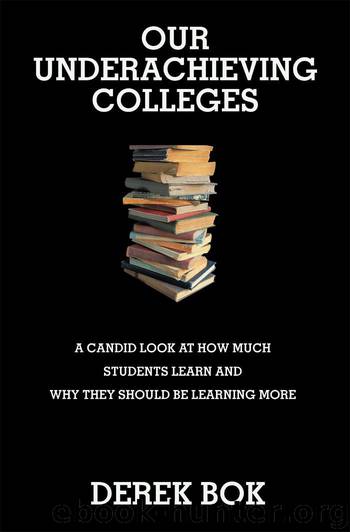
Author:Derek Bok [Bok, Derek]
Language: eng
Format: mobi
ISBN: 9781400831333
Publisher: Princeton University Press
Published: 2009-02-28T00:00:00+00:00
TOWARD A COMPREHENSIVE PROGRAM OF INTERPERSONAL RELATIONS
Efforts to promote understanding among blacks and whites and men and women are not the only ways to improve the interpersonal capabilities of students. A full agenda could include many other items as well: developing the skills of collaboration, persuasion, and negotiation; expanding capacities for leadership; improving the ability to listen perceptively and acquire greater insight into the feelings and motivations of others. In earlier times, colleges rarely paid attention to this agenda but simply threw students together in living units and extracurricular activities, leaving them to learn for themselves how to get along with one another. The growth of diversity programs, however, coupled with the progress of researchers in exploring other aspects of human relations, invites the question whether colleges should recognize the development of interpersonal skills as a major aim of undergraduate education, to be consciously pursued through a mixture of formal coursework and extracurricular experiences.*
This issue will surely arouse strong feelings on either side. On the one hand, traditionalists will argue that the study of human relations, at least in terms as broad as this chapter suggests, has not reached sufficient maturity to warrant an important place in the curriculum. Courses on topics such as leadership, cooperation, and sensitivity to others arguably lack a substantial base of empirically tested observations. At best, such subjects are little more than a kind of skill training akin to learning the rules of etiquette or the methods for running a productive meeting—useful things to know but hardly the stuff of serious undergraduate teaching. At worst, such training can degenerate into attempts to teach students how to manipulate others for personal advantage.
On the other hand, proponents will point out that interpersonal competence is vitally important to many students. Success in life often requires it. Employers increasingly demand it. The nation needs it if America is to maintain a cohesive society and an effective democracy with a population increasingly splintered by racial, religious, and ideological differences. Happiness itself comes in no small measure from having fulfilling personal relationships. In short, the subject is simply too important to be ignored during such a formative time in students’ lives.
As for the claim that courses in interpersonal relations consist of teaching “mere” skills or, worse yet, the black arts of manipulation, much the same could be said of classes on writing. Yet composition has long been a compulsory course in most American colleges. Besides, the study of interpersonal relations has certainly progressed beyond a mixture of self-evident banalities and unsubstantiated theories. Most important aspects of the subject rest on substantial bodies of research and appear in regular courses offered by psychology departments and professional schools.
The differences of opinion over interpersonal competence must be seen as part of a more pervasive tension, mentioned in Chapter 2. On the one hand, most liberal arts professors are chiefly interested in conveying knowledge and understanding, the more profound and the more empirically verifiable the better. On the other hand, most students (and the organizations
Download
This site does not store any files on its server. We only index and link to content provided by other sites. Please contact the content providers to delete copyright contents if any and email us, we'll remove relevant links or contents immediately.
The Art of Coaching Workbook by Elena Aguilar(51160)
Trainspotting by Irvine Welsh(21643)
Twilight of the Idols With the Antichrist and Ecce Homo by Friedrich Nietzsche(18622)
Fangirl by Rainbow Rowell(9228)
Periodization Training for Sports by Tudor Bompa(8253)
Change Your Questions, Change Your Life by Marilee Adams(7759)
This Is How You Lose Her by Junot Diaz(6877)
Asking the Right Questions: A Guide to Critical Thinking by M. Neil Browne & Stuart M. Keeley(5758)
Grit by Angela Duckworth(5604)
Red Sparrow by Jason Matthews(5467)
Paper Towns by Green John(5177)
Room 212 by Kate Stewart(5105)
Ken Follett - World without end by Ken Follett(4723)
Housekeeping by Marilynne Robinson(4436)
The Sports Rules Book by Human Kinetics(4379)
Papillon (English) by Henri Charrière(4262)
Double Down (Diary of a Wimpy Kid Book 11) by Jeff Kinney(4261)
The Motorcycle Diaries by Ernesto Che Guevara(4089)
Exercise Technique Manual for Resistance Training by National Strength & Conditioning Association(4061)
